Tsampa: The Staple of the Himalayas – Culture, Nutrition, and Tradition

Tsampa, a roasted barley flour, is widely regarded as the staple food of Tibetan and Himalayan communities. Its significance extends beyond simple sustenance; it embodies the resilience, culture, and spiritual practices of people who inhabit some of the world’s most remote and high-altitude regions. In Nepal, particularly in areas like Humla, Mustang, Dolpo, and other highland valleys, Tsampa has nourished generations living in environments where harsh winters, scarce arable land, and limited access to external markets define daily life. Barley, the primary ingredient, is uniquely suited to these conditions, thriving in cold climates and at elevations where other grains struggle. Roasting barley to make Tsampa not only preserves it for long periods but also enhances its digestibility and nutritional profile, making it a lifeline for people whose survival depends on reliable, high-calorie food.
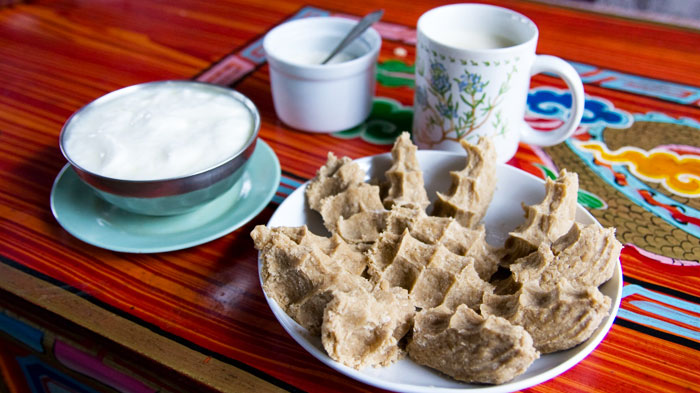
The preparation of Tsampa is both simple and versatile, yet it carries deep cultural and practical importance. Traditionally, barley is harvested and sun-dried before being roasted over open flames or clay ovens. This roasting process gives the grain a nutty aroma and ensures it can be stored for months without spoiling. Once roasted, the grains are ground into fine flour using stone mills or modern grinders. The resulting Tsampa flour can be eaten directly, mixed with water or milk, or combined with butter tea—a mixture of tea, yak butter, and salt—to form a dough-like consistency. The combination of Tsampa and butter tea is particularly important in high-altitude regions, providing a balance of carbohydrates, fats, and proteins to sustain energy and warmth throughout the day. Tsampa can also be incorporated into yogurt, fermented beverages, or even mixed with honey, nuts, and dried fruits to create variations that suit both traditional and modern tastes.
Culturally, Tsampa occupies a central place in the social and spiritual life of Himalayan communities. In Tibetan Buddhism, Tsampa is used in ceremonial rituals, where it is thrown into the air during festivals and celebrations to symbolize happiness, prosperity, and the release of obstacles. In Nepal, particularly in Humla, Tsampa is often offered to guests as a sign of hospitality, incorporated into rituals marking births and weddings, or used in seasonal festivals. This dual role—as both food and cultural symbol—illustrates its importance beyond mere nutrition. It serves as a tangible link between daily sustenance, communal identity, and spiritual practice, creating continuity between the past and present.
From a nutritional perspective, Tsampa is remarkably efficient, particularly for high-altitude living. Barley is rich in complex carbohydrates that provide sustained energy, dietary fiber for digestive health, and essential minerals such as iron, magnesium, phosphorus, and zinc. It also contains B vitamins critical for energy metabolism and cognitive function. When combined with yak butter or milk, the protein and fat content is enhanced, making it a complete meal capable of sustaining individuals engaged in labor-intensive activities such as trekking, herding, or farming. Scientific studies have shown that diets based on barley can enhance endurance and physical resilience in challenging environments, which helps explain why Tsampa has remained a staple for centuries. The roasting process improves digestibility, ensuring that even under physically taxing conditions, the body can extract maximum nutritional benefit with minimal gastrointestinal stress.
The culinary versatility of Tsampa extends to a variety of preparations. While the classic method involves kneading it with butter tea, locals often adapt it according to available ingredients. Some households mix Tsampa with yogurt, milk, or fermented beverages to achieve different flavors, while modern adaptations include energy bars, smoothies, and baked goods that cater to urban tastes. Despite these innovations, the traditional preparation remains dominant in rural Himalayan villages, where the taste, aroma, and texture of Tsampa mixed with butter tea or milk are irreplaceable. The coexistence of traditional and contemporary uses highlights both the resilience and adaptability of Himalayan culinary culture. Tsampa is thus not just a staple; it is a cultural artifact that evolves alongside the communities that sustain it.
The social dimension of Tsampa consumption is equally important. In many Himalayan households, the preparation and consumption of Tsampa is a communal activity. Families gather to roast the barley, grind it into flour, and mix it into dough, often accompanied by storytelling or singing. This process strengthens family bonds and reinforces social norms, passing down culinary techniques and cultural knowledge from elders to younger generations. During festivals, weddings, and communal gatherings, Tsampa is shared among community members, symbolizing unity, generosity, and mutual respect. In this way, Tsampa transcends its nutritional value, acting as a medium for social cohesion, intergenerational learning, and the transmission of cultural identity.
The survival and adaptability aspects of Tsampa are particularly noteworthy. In remote areas like Humla, access to external food markets is limited, especially during harsh winters when villages may be isolated for months. Tsampa, with its long shelf life and high caloric content, provides a dependable food source that can sustain communities through these periods. Nomadic herders, traders, and mountaineers have historically relied on Tsampa for sustenance during long treks across high-altitude passes, where fresh food is unavailable. Its portability, nutritional density, and storage stability make it an ideal provision for journeys and labor-intensive work. Tsampa is thus not only food but also a strategic resource that has enabled generations to thrive in some of the harshest environments on Earth.
Tsampa also reflects a deep connection to the spiritual and cultural life of Himalayan communities. Oral histories, songs, and proverbs frequently reference barley and Tsampa, portraying them as symbols of life, endurance, and divine providence. In festivals such as Losar (Tibetan New Year) and local harvest celebrations, Tsampa plays a central role, often thrown into the air as an expression of joy and gratitude. In Humla and Mustang, the reverence with which Tsampa is treated—careful preparation, ceremonial sharing, and communal consumption—underscores its status as both a material and symbolic staple. It is a food that nourishes not only the body but also the spirit, creating a link between sustenance, tradition, and identity.
Regional variations in Tsampa preparation further illustrate its cultural richness. In Humla, Tsampa is often coarser and mixed generously with yak butter or cheese, reflecting the high-altitude environment and pastoral lifestyle. In Mustang, the flour may be finer and occasionally mixed with local herbs or dried fruits, highlighting regional tastes and available resources. Dolpo communities may incorporate Tsampa into fermented beverages or use it as a thickener for soups and stews, demonstrating creative adaptations to local dietary preferences. These regional differences reflect the flexibility and ingenuity of Himalayan culinary traditions, allowing a single staple to meet diverse nutritional, cultural, and culinary needs across the region.
Personal anecdotes from locals and travelers reveal the centrality of Tsampa in daily life. Elderly residents in Humla recall eating Tsampa as a primary meal for decades, emphasizing its role in sustaining energy during long days of farming or herding. Trekkers in Mustang describe it as a lifesaver during high-altitude treks, noting its quick preparation and ability to provide immediate warmth and nutrition. For children, Tsampa mixed with butter tea is both comforting and energizing, providing sustenance through school days and outdoor chores. These stories illustrate how Tsampa functions as both a practical food source and a deeply ingrained part of social and personal experience, bridging generations and connecting individuals to the landscape and culture of the Himalayas.
The preparation of Tsampa is also an art in itself, with household techniques reflecting both practicality and tradition. Roasting the barley requires constant attention to ensure uniform browning without burning. Grinding it into flour can be accomplished with traditional stone mills, which lend a unique texture, or with modern mechanical grinders that produce finer flour for diverse culinary applications. Mixing Tsampa with butter tea or milk is done with careful attention to consistency, ensuring the right balance of moisture and texture. The flour can be stored for months in airtight containers or cloth bags, highlighting its practicality as a preserved, high-calorie food. In festivals and religious offerings, the preparation may be accompanied by ritual chants, prayers, or songs, reinforcing Tsampa’s dual role as both nourishment and cultural symbol.
In modern urban contexts, Tsampa has found new applications that combine tradition with contemporary culinary innovation. Health-conscious individuals and athletes are turning to Tsampa for its high-fiber content, slow-digesting carbohydrates, and balanced nutrition. Recipes now incorporate Tsampa into energy bars, breakfast cereals, and smoothies, making it accessible to people beyond its traditional Himalayan context. Despite these adaptations, many urban Nepalis and Tibetans continue to honor traditional preparation methods, blending the flour with butter tea or milk in the morning, maintaining a tangible link to ancestral practices. This continuity amidst innovation highlights the enduring cultural significance of Tsampa, ensuring that it remains a living tradition rather than a relic of the past.
Scientific research into the nutritional benefits of Tsampa has corroborated the empirical knowledge of Himalayan communities. Studies have shown that barley is rich in beta-glucan, a soluble fiber that helps regulate blood sugar levels and reduce cholesterol. Its combination with fat from yak butter provides a balanced macronutrient profile, sustaining energy during high-altitude exertion. Additionally, barley contains antioxidants, vitamins, and minerals essential for overall health. The roasting process not only enhances flavor but may also improve digestibility, making Tsampa a practical and scientifically sound food source for people living in extreme environments. These insights reinforce the wisdom embedded in traditional dietary practices, illustrating how centuries of experience have optimized Tsampa as a staple for both survival and well-being.
The role of Tsampa in trekking and tourism cannot be overlooked. High-altitude treks across Mustang, Dolpo, and Humla often expose visitors to long days of walking in low-oxygen environments, where maintaining energy and warmth is crucial. Trekkers often rely on Tsampa-based meals or snacks provided by local teahouses or guides. The flour’s quick preparation and high caloric content make it ideal for on-the-go consumption, allowing trekkers to maintain stamina and avoid fatigue. Beyond its nutritional value, Tsampa also serves as a cultural introduction, giving visitors a taste of Himalayan life and connecting them to local traditions. Sharing Tsampa with trekkers often becomes a point of hospitality, showcasing the warmth and generosity of local communities.
Tsampa’s spiritual and ritual significance is further illustrated in local festivals and religious practices. In Losar celebrations, for instance, throwing Tsampa flour is an act of joy and blessing, symbolizing abundance, happiness, and the dispelling of negativity. Monasteries often use Tsampa in offerings to deities, integrating it into prayers, rituals, and meditative practices. The flour thus transcends its material function, becoming a medium through which spiritual meaning, social identity, and cultural continuity are expressed. Its presence in both mundane and sacred contexts highlights its multifaceted role, blending nourishment, symbolism, and communal experience.
Finally, Tsampa is a testament to the ingenuity, resilience, and adaptability of Himalayan communities. It embodies centuries of accumulated knowledge, connecting survival strategies, culinary techniques, and cultural practices into a single, enduring staple. Its combination of practicality, nutrition, flavor, and symbolic significance ensures that Tsampa remains central to life in high-altitude regions. Whether consumed as a simple daily meal, shared during festivals, or adapted for modern culinary trends, Tsampa continues to nourish both body and spirit, maintaining its place as an irreplaceable part of Himalayan heritage. The continued reverence for Tsampa, from Humla to urban centers, illustrates the enduring connection between people, their environment, and the foods that sustain them, making it a rare and remarkable culinary and cultural treasure.
Categories:
Food & Drink
Tags:
Tsampa
,
BarleyFlour
,
Superfoods
,
TsampaFlour
,
EnergyBoostFood
,
HighProteinFood